Tuesday, December 13, 2011
Final Assessments
I was able to finish up the final assessments, and the kids did great! They were very good at mirroring movements that I did, and they were great at stretching. Some things that came more difficult to the children were throwing a bean bag at a target on the wall and some children had trouble catching a bouncy ball. They are great at listening and following directions. I know they have a lot of fun in Land Sharks, and I have had a great time as well! The Lakeshore Foundation does an amazing job helping people with disabilities, and I know each of the children that attended Land Sharks enjoyed every hop, stretch, and run of it!

Tuesday, November 29, 2011
Swimming
The children in the Learn-to-Swim part of Land Sharks sure do have a fun time learning to swim! Here are a few pictures of the kids in action!


Saturday, November 12, 2011
Success!
Part of the Land Sharks class is a learn-to-swim lesson for about 40 minutes in the Lakeshore Foundation pool. It is a therapy pool, so it is pretty warm! Because each child has a different disability, and each child is a different age, the instructors try to divide the children into groups based on their ability to swim. Teaching a child, any child, to swim can sometimes be a challenge! There are usually enough instructors for each of us to take 2 children each. This is nice because the children get more one-on-one time and more time to swim up and down the pool. (Not a far distance, but enough to wear them out!) Based on the child's ability to swim, the instructor either helps the child stay on top of the water, or lets the child swim independently, giving the child suggestions along the way. I usually take 2-3 children that need help swimming. It is very fun to see their different personalities in the pool! There is one little girl that will only swim with specific instructors; myself being one of them. She is not afraid to let you know what is on her mind, and if she does not want to do something, she will not do it. I have been swimming with her for a few weeks now, and she is getting more and more comfortable in the water. There was one we could not get her to do- try swimming on her back. I can imagine how scary that would be to not see where you are going and completely trust the instructor to not let you sink! Through a little perseverance, and a lot of encouragement, she finally swam on her back! And she did a great job, too! We were all so proud of her, as was her grandmother and the other parents watching the lesson- they all applauded the accomplishment. She was one excited little girl! Success!
Friday, October 28, 2011
Disabilities to Overcome
In this Land Sharks class, each one of the children has a different disability. In preparing for this project, I have been doing a little research on their disabilities and wanted to share some the problems these children have to overcome in order to do the different activities that are being asked of them.
Cerebral Palsy: Cerebral palsy is a group of disorders that can involve brain and nervous system functions such as movement, learning, hearing, seeing, and thinking.
Parents may notice that their child is delayed in reaching, and in developmental stages such as sitting, rolling, crawling, or walking.
Symptoms of spastic cerebral palsy, the most common type, include:
Apraxia: Apraxia is a disorder of the brain and nervous system in which a person is unable to perform tasks or movements when asked, even though:
Spina Bifida: Myelomeningocele is a birth defect in which the backbone and spinal canal do not close before birth. The condition is a type of spina bifida.
A newborn may have a sac sticking out of the mid to lower back. The doctor cannot see through the sac when shining a light behind it. Symptoms include:
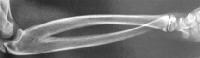

The degree of fusion in radioulnar synostosis varies and may or may not involve the radial head.
CHARGE Syndrome: CHARGE syndrome is a recognizable (genetic) pattern of birth defects which occurs in about one in every 9-10,000 births worldwide. It is an extremely complex syndrome, involving extensive medical and physical difficulties that differ from child to child. The vast majority of the time, there is no history of CHARGE syndrome or any other similar conditions in the family. Babies with CHARGE syndrome are often born with life-threatening birth defects, including complex heart defects and breathing problems. They spend many months in the hospital and undergo many surgeries and other treatments. Swallowing and breathing problems make life difficult even when they come home. Most have hearing loss, vision loss, and balance problems which delay their development and communication. All are likely to require medical and educational intervention for many years. Despite these seemingly insurmountable obstacles, children with CHARGE syndrome often far surpass their medical, physical, educational, and social expectations.
A couple of the other disabilities are developmental delay and chromosomal issues.
I got the information from PubMed as well as chargesyndrome.org to explain these disabilities.
Regardless of what the disability is, these children are spirited, driven, and have the time of their life playing games and swimming across the pool. They are so inspiring!
Cerebral Palsy: Cerebral palsy is a group of disorders that can involve brain and nervous system functions such as movement, learning, hearing, seeing, and thinking.
Parents may notice that their child is delayed in reaching, and in developmental stages such as sitting, rolling, crawling, or walking.
Symptoms of spastic cerebral palsy, the most common type, include:
- Muscles that are very tight and do not stretch. They may tighten up even more over time.
- Abnormal walk (gait): arms tucked in toward the sides, knees crossed or touching, legs make "scissors" movements, walk on the toes
- Joints are tight and do not open up all the way (called joint contracture)
- Muscle weakness or loss of movement in a group of muscles (paralysis)
- The symptoms may affect one arm or leg, one side of the body, both legs, or both arms and legs
- Abnormal movements (twisting, jerking, or writhing) of the hands, feet, arms, or legs while awake, which gets worse during periods of stress
- Unsteady gait
- Tremors
- Loss of coordination
- Floppy muscles, especially at rest, and joints that move around too much
Apraxia: Apraxia is a disorder of the brain and nervous system in which a person is unable to perform tasks or movements when asked, even though:
- The request or command is understood
- They are willing to perform the task
- The muscles needed to perform the task work properly
- The task may have already been learned
Spina Bifida: Myelomeningocele is a birth defect in which the backbone and spinal canal do not close before birth. The condition is a type of spina bifida.
A newborn may have a sac sticking out of the mid to lower back. The doctor cannot see through the sac when shining a light behind it. Symptoms include:
- Loss of bladder or bowel control
- Partial or complete lack of sensation
- Partial or complete paralysis of the legs
- Weakness of the hips, legs, or feet of a newborn
- Abnormal feet or legs, such as clubfoot
- Build up of fluid inside the skull (hydrocephalus)
- Hair at the back part of the pelvis called the sacral area
- Dimpling of the sacral area
The degree of fusion in radioulnar synostosis varies and may or may not involve the radial head.
CHARGE Syndrome: CHARGE syndrome is a recognizable (genetic) pattern of birth defects which occurs in about one in every 9-10,000 births worldwide. It is an extremely complex syndrome, involving extensive medical and physical difficulties that differ from child to child. The vast majority of the time, there is no history of CHARGE syndrome or any other similar conditions in the family. Babies with CHARGE syndrome are often born with life-threatening birth defects, including complex heart defects and breathing problems. They spend many months in the hospital and undergo many surgeries and other treatments. Swallowing and breathing problems make life difficult even when they come home. Most have hearing loss, vision loss, and balance problems which delay their development and communication. All are likely to require medical and educational intervention for many years. Despite these seemingly insurmountable obstacles, children with CHARGE syndrome often far surpass their medical, physical, educational, and social expectations.
A couple of the other disabilities are developmental delay and chromosomal issues.
I got the information from PubMed as well as chargesyndrome.org to explain these disabilities.
Regardless of what the disability is, these children are spirited, driven, and have the time of their life playing games and swimming across the pool. They are so inspiring!
Tuesday, October 11, 2011
YOGA
I want to take a minute to describe the "Land" part of Land Sharks. The children arrive at the Lakeshore Foundation at 4pm on Mondays and Wednesdays. They come down to an aerobics room where we have lots of fun! This part of the class lasts 40 minutes. We play all kinds of games that help the children focus, and work on their movement. Sometimes we play on little scooters and play red light, green light. The children sit on the scooter and when the teacher says, "green light"- they go! When "red light" is said, the children must stop. We make up other colors and rules to make it a little harder! One exercise that we have been doing lately is yoga. The kids really seem to enjoy it, and the funny names of the different moves are fun too! I took a few pictures of the kids doing yoga!


"Strong Warrior"


Work together!

"Butterfly"- this one is a favorite!

Reach for the sun!!

Stretch it out!
Thursday, September 8, 2011
A Few Weeks In
My name is Mandy Linford, and I am an honors student in the School of Nursing at the University of Alabama at Birmingham. For my honors project I get the opportunity to help at the Lakeshore Foundation in a child's aerobic/water class called Land Sharks. Cute, huh? This class is for children between the ages of 4-7 with some kind of disability. For my project I am completing a pre and post assessment of the children using a program called: APEAS II- Adapted Physical Education Assessment Scale. This scale measures how well the children can do things such as: skip, catch, run, kick, balance, and throw. Because this class is just starting, I am able to measure their abilities now so that at the end of their classes in December, I can see how well they have improved. So far I have assessed most of the children in the class and have had a blast helping them play!
Subscribe to:
Posts (Atom)