Cerebral Palsy: Cerebral palsy is a group of disorders that can involve brain and nervous system functions such as movement, learning, hearing, seeing, and thinking.
Parents may notice that their child is delayed in reaching, and in developmental stages such as sitting, rolling, crawling, or walking.
Symptoms of spastic cerebral palsy, the most common type, include:
- Muscles that are very tight and do not stretch. They may tighten up even more over time.
- Abnormal walk (gait): arms tucked in toward the sides, knees crossed or touching, legs make "scissors" movements, walk on the toes
- Joints are tight and do not open up all the way (called joint contracture)
- Muscle weakness or loss of movement in a group of muscles (paralysis)
- The symptoms may affect one arm or leg, one side of the body, both legs, or both arms and legs
- Abnormal movements (twisting, jerking, or writhing) of the hands, feet, arms, or legs while awake, which gets worse during periods of stress
- Unsteady gait
- Tremors
- Loss of coordination
- Floppy muscles, especially at rest, and joints that move around too much
Apraxia: Apraxia is a disorder of the brain and nervous system in which a person is unable to perform tasks or movements when asked, even though:
- The request or command is understood
- They are willing to perform the task
- The muscles needed to perform the task work properly
- The task may have already been learned
Spina Bifida: Myelomeningocele is a birth defect in which the backbone and spinal canal do not close before birth. The condition is a type of spina bifida.
A newborn may have a sac sticking out of the mid to lower back. The doctor cannot see through the sac when shining a light behind it. Symptoms include:
- Loss of bladder or bowel control
- Partial or complete lack of sensation
- Partial or complete paralysis of the legs
- Weakness of the hips, legs, or feet of a newborn
- Abnormal feet or legs, such as clubfoot
- Build up of fluid inside the skull (hydrocephalus)
- Hair at the back part of the pelvis called the sacral area
- Dimpling of the sacral area
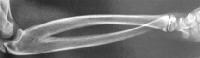

The degree of fusion in radioulnar synostosis varies and may or may not involve the radial head.
CHARGE Syndrome: CHARGE syndrome is a recognizable (genetic) pattern of birth defects which occurs in about one in every 9-10,000 births worldwide. It is an extremely complex syndrome, involving extensive medical and physical difficulties that differ from child to child. The vast majority of the time, there is no history of CHARGE syndrome or any other similar conditions in the family. Babies with CHARGE syndrome are often born with life-threatening birth defects, including complex heart defects and breathing problems. They spend many months in the hospital and undergo many surgeries and other treatments. Swallowing and breathing problems make life difficult even when they come home. Most have hearing loss, vision loss, and balance problems which delay their development and communication. All are likely to require medical and educational intervention for many years. Despite these seemingly insurmountable obstacles, children with CHARGE syndrome often far surpass their medical, physical, educational, and social expectations.
A couple of the other disabilities are developmental delay and chromosomal issues.
I got the information from PubMed as well as chargesyndrome.org to explain these disabilities.
Regardless of what the disability is, these children are spirited, driven, and have the time of their life playing games and swimming across the pool. They are so inspiring!

No comments:
Post a Comment